


How Businesses use MPOS (Mobile Point of Sale Systems) to Absorb Demand Spikes
The lunch rush hits at 12:47 pm. Your queue stretches to the door. Three staff members are frantically working the single counter whilst frustrated customers check their watches, calculating whether they'll make it back to the office on time. Two potential sales walk out. Another busy period, another pile of missed revenue.
This scene plays out across thousands of UK businesses every single day. Whether you're running a café in Manchester, a stadium kiosk, or a food truck at a summer festival, demand spikes are simultaneously your biggest opportunity and your greatest operational nightmare. The question isn't whether these surges will happen. It's whether your business can actually capitalise on them.
Mobile Point of Sale (MPOS) technology has fundamentally changed this equation. By untethering payment processing from fixed counters, MPOS can absorb demand spikes, allowing your team to meet customers where they are, precisely when peaks occur. For UK businesses facing everything from unpredictable British weather to seasonal tourism floods, using MPOS to absorb demand spikes isn't just convenient technology. It's the difference between thriving during rushes and watching revenue slip away.
The Queue Busting Revolution: Mobility That Matches Demand

When your business model requires movement or when demand spreads across multiple locations, fixed checkout points create natural bottlenecks. Every customer must come to that one location, regardless of how many staff you have or how efficiently they work.
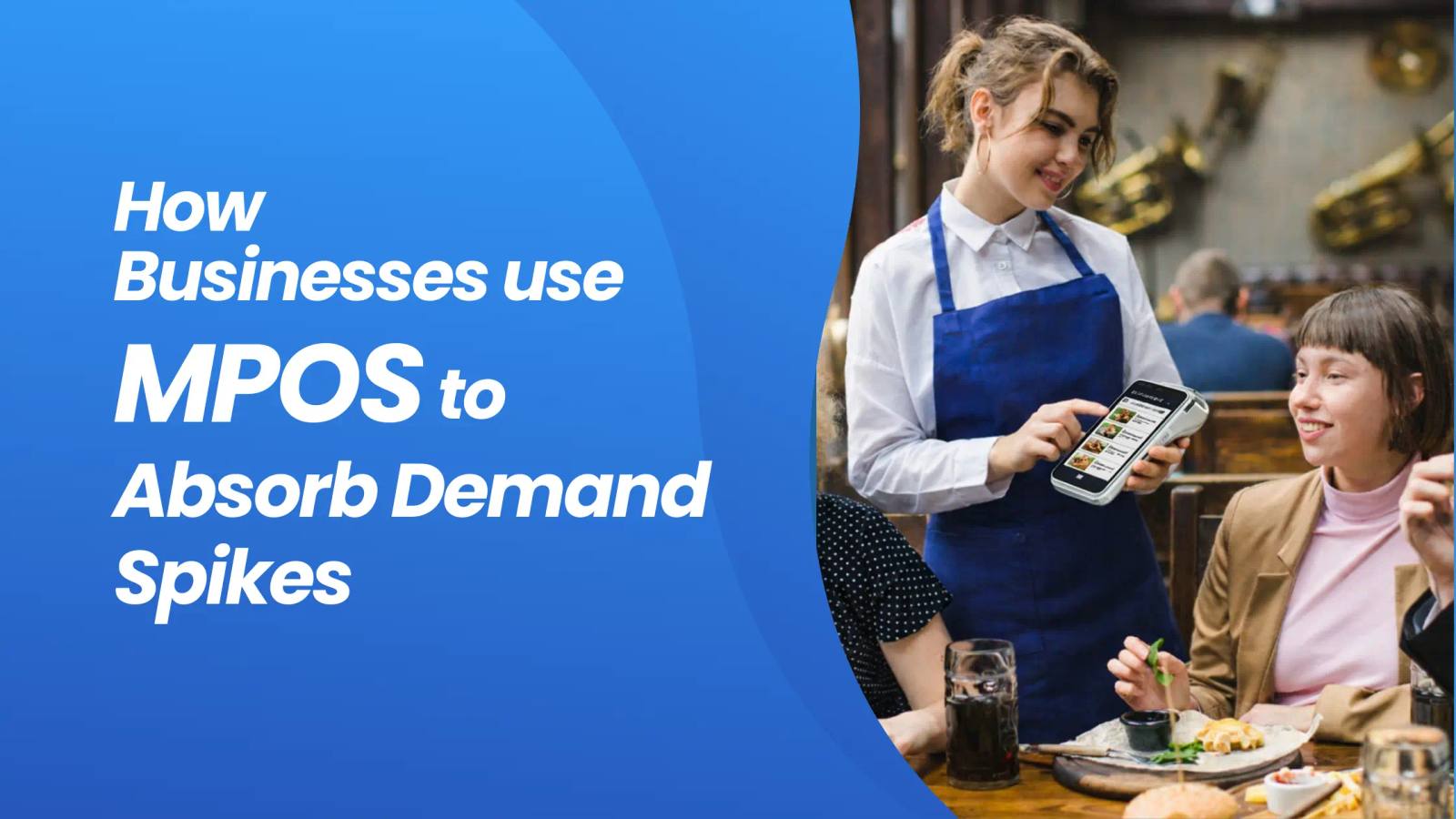
MPOS to absorb demand spikes works by bringing the checkout directly to customers. Your team can take orders and process payments anywhere: at tables, in queues, at outdoor seating areas, in stadium stands, at client locations, or even from a moving vehicle.
Here's what mobility enables across different business types:
- Cafés and restaurants: Servers take payment tableside during the dinner rush, eliminating waiting time and accelerating table turnover
- Mobile businesses: Food trucks, market stalls, and pop-up vendors process transactions wherever they set up, without needing fixed infrastructure
- Salons and spas: Stylists and therapists complete payments at their stations, maintaining the personalised client experience
- Stadium and venue operations: Staff work the concourse during half-time, taking orders from supporters without forcing them to queue
- Cab and rental services: Drivers process payments in-vehicle, providing seamless checkout experiences
- Retail and events: Multiple team members work the crowd simultaneously during peak trading periods
The impact during peak periods is dramatic. Instead of funnelling everyone through a single location, you can deploy multiple staff members to serve customers simultaneously. When demand doubles, your capacity doubles. This is how businesses deploy MPOS to absorb demand spikes without compromising service quality.
Kayana's MPOS solutions enable precisely this flexibility, working alongside your existing EPOS systems whilst giving staff the freedom to serve customers wherever they're needed most.
Real-Time Integration: Every Device Connected, Every Order Tracked

Mobility creates value only when paired with seamless system integration. An order taken on a mobile device must reach your kitchen, update your inventory, and sync with your central dashboard instantly.
Modern MPOS systems that absorb demand spikes achieve this through direct backend communication. When a staff member enters an order, it transmits immediately to Kitchen Display Systems (KDS) or fulfilment printers. There's no manual re-entry, no verbal relay across a noisy venue, no paper tickets that can be lost in the chaos.
| Integration Point | Real-Time Benefit | Impact During Demand Spikes |
|---|---|---|
| Kitchen Display Systems | Orders appear instantly on KDS screens | Kitchen staff prioritise efficiently without bottlenecks |
| Inventory Management | Stock levels update with every sale | Prevent customers ordering sold-out items mid-rush |
| Central Dashboard | Live transaction and sales data | Managers make informed staffing decisions on the fly |
| Multi-Channel Sync | MPOS and self-service kiosks share data | Complete operational visibility across all touchpoints |
Kayana's integrated ecosystem ensures that MPOS devices communicate seamlessly with Kitchen Display Systems, EPOS platforms, and inventory management tools. Every transaction syncs automatically, maintaining operational control even when your venue is at peak capacity.
This real-time synchronisation transforms how you manage busy periods. Instead of discovering problems after the rush ends, you can identify and address issues as they emerge.
Tired of Disconnected Systems During Rush Periods?
Kayana's integrated MPOS ensures every order reaches your kitchen instantly, inventory updates in real-time, and managers have complete visibility!

Payment Speed: The Frictionless Checkout Advantage
During demand spikes, every second at checkout multiplies across dozens or hundreds of transactions. A payment process that takes 30 seconds instead of 10 doesn't just slow things down; it also costs more. It fundamentally limits the number of customers you can serve.
Modern MPOS systems support the full spectrum of fast payment methods that UK consumers expect:
| Payment Method | Transaction Speed | Key Advantage |
|---|---|---|
| Contactless Card | 2-5 seconds | No PIN entry required for most transactions |
| Apple Pay / Google Pay | 1-3 seconds | Biometric authentication, instant approval |
| QR Code Payments | 5-10 seconds | Works in areas with variable connectivity |
| Chip & PIN | 15-25 seconds | Fallback for high-value transactions |
Contactless payments have become the dominant transaction method across Britain. Customers simply tap their card or phone against the reader, and they're done. No PIN entry, no signature, no fumbling for exact change.
Digital wallets like Apple Pay and Google Pay leverage biometric authentication that customers have already configured on their devices. The checkout feels instantaneous, keeping queues moving even during intense rushes.
QR code payments provide flexibility for outdoor venues or events where signal strength varies. Customers scan and pay through their banking app, ensuring transactions proceed even when network connectivity is unavailable.
Beyond pure speed, payment versatility delivers a documented commercial benefit. Research indicates that frictionless checkout experiences can increase average order values by up to 12%. When customers don't feel the friction of a lengthy payment process, they're more comfortable adding extras or upgrading their selections.
Kayana's MPOS hardware supports these modern payment methods whilst maintaining the security and compliance standards required for high-volume commercial environments. Transactions process quickly without compromising the encryption and authentication that protect both business and customer data.
Staff Empowerment: Training Teams to Use MPOS to Absorb Demand Spikes
Demand spikes often coincide with periods when you're relying on temporary or seasonal staff. A complex, counter-intuitive POS system becomes a serious liability when you need to train people quickly.
| Training Aspect | Complex Systems | Modern MPOS |
|---|---|---|
| Time to competency | 2-5 days | 2-4 hours |
| Learning curve | Steep, requires memorisation | Intuitive, visual interface |
| Error rate (new staff) | Higher during rush periods | Reduced through confirmation screens |
| Customer interaction | Staff face screen, not the customer | Direct engagement, real-time confirmation |
Modern MPOS systems prioritise usability:
- Intuitive touchscreen interfaces that require minimal training
- Logical menu structures that new staff can navigate confidently
- Streamlined workflows that reduce the steps between order and payment
- Clear visual feedback that prevents errors before they happen
This ease of use proves invaluable when staffing up for Bank Holiday weekends, summer festival seasons, or special events. Team members can become productive in hours rather than days.
The mobility itself improves service quality. Staff entering orders directly at the customer's side can confirm selections immediately, with customers seeing their order built in real-time. This eliminates the communication gaps that create errors when orders pass through multiple people before reaching the kitchen.
The result: fewer mistakes, less waste, and significantly better customer experiences during the high-stakes moments when your reputation is most visible.
Real-World Scenarios: How Businesses Use MPOS to Absorb Demand Spikes
Understanding theory is valuable. Seeing how MPOS performs in actual peak-demand environments provides the real proof.
| Scenario | Demand Spike Trigger | MPOS Solution | Business Impact |
|---|---|---|---|
| Cafés & Restaurants | Lunch and dinner rushes | Tableside ordering and payment | Supporters served without missing a play |
| Mobile Food Vendors | Festival crowds, event catering | Staff work in concourses with mobile devices | Convert waiting crowds into completed sales |
| Salons & Spas | Saturday appointments, holiday season | Station-side checkout | Maintain personalised service during busy periods |
| Stadium Operations | Pre-match & half-time (15–20 min windows) | Supporters served without missing a play | Supporters served without missing play |
| Rental Services | Peak season, weekend rushes | In-vehicle or on-site payment processing | Process orders anywhere in the queue |
Cafés and Restaurants: Serving the Rush

During peak lunch and dinner services, the ability to take payments at the table transforms operational flow. Customers don't wait for bills to arrive, staff don't run back and forth to process payments, and tables turn over faster.
MPOS-equipped staff who can absorb demand spikes can handle multiple table payments simultaneously, dramatically reducing the bottleneck that often occurs when everyone wants to leave at once. This proves particularly valuable for city centre cafés serving time-pressed office workers or restaurants managing evening booking slots.
Mobile and Pop-Up Businesses: Service Without Infrastructure

Food trucks, market stalls, festival vendors, and pop-up shops operate in environments where permanent infrastructure isn't feasible. When a headline act finishes, and thousands of attendees simultaneously want refreshments, or when a market day draws unexpectedly large crowds, it becomes essential for MPOS to absorb demand spikes.
Multiple team members equipped with mobile devices can work the queue simultaneously, each processing transactions independently. The hardware must handle outdoor conditions, variable connectivity, and constant movement, exactly what Kayana's MPOS devices are engineered to provide.
Salons and Beauty Services: Maintaining the Experience

High-end salons and spas pride themselves on personalised service. During busy Saturdays or pre-holiday rushes, maintaining that experience whilst managing increased client volume requires flexibility.
MPOS to absorb demand spikes allows stylists and therapists to complete transactions at their stations, avoiding the disruption of sending clients to a reception desk. The checkout becomes a natural extension of the service conversation, preserving the premium experience even during peak periods.
Stadium and Venue Operations: Capturing Time-Limited Demand

Football matches and concerts create intense, time-limited demand windows. Thousands of supporters arrive before kickoff or seek refreshments during a 15-minute halftime interval.
Rather than relying solely on fixed kiosks that create inevitable queues, MPOS enables staff to absorb demand spikes and work the crowd directly. Orders process quickly, supporters don't miss critical moments, and venues maximise revenue during these brief but profitable windows.
Rental and Service Businesses: Mobility Meets Convenience

Taxi firms, car rental agencies, equipment hire companies, and mobile repair services often complete transactions at customer locations or in vehicles. MPOS to absorb demand spikes provides the flexibility to process payments wherever the service occurs, without requiring customers to visit an office or wait for invoicing.
During peak seasons, summer holidays for car rentals, match days for taxi services, or seasonal events for equipment hire, the ability to process high transaction volumes quickly and securely makes the difference between smooth operations and frustrated customers.
Ready to Scale Your Service During Peak Demand?
Discover how Kayana's integrated MPOS solutions help UK businesses serve more customers faster, even during the busiest trading periods. Get expert guidance tailored to your business needs.
Strategic Intelligence: Data-Driven Demand Management
Beyond immediate operational benefits, MPOS provides strategic intelligence that helps you better manage and anticipate future peak periods.
| Data Insight | What It Reveals | Actionable Decision |
|---|---|---|
| Real-time inventory levels | Which items are selling rapidly during the rush | Remove sold-out items from all channels instantly |
| Transaction volume patterns | When peaks occur and their intensity | Optimise staff scheduling for future events |
| Average order values | How spending changes during busy periods | Adjust menu pricing and promotions strategically |
| Item performance by event type | What sells best at specific occasions | Tailor inventory for different demand spike scenarios |
| Staff efficiency metrics | Which team members process orders fastest | Deploy top performers during critical rush periods |
Real-time inventory visibility allows dynamic menu management. When popular items sell rapidly during a rush, your system alerts you immediately rather than revealing shortages when customers try to order. Remove sold-out items from all ordering channels instantly, preventing the frustration of unfulfillable orders.
Sales analytics help you better prepare for future peaks. Historical data reveals which items sell fastest during specific event types, when transaction volumes peak, and how average order values fluctuate throughout busy periods.
Kayana's integrated platform ensures these insights span your entire operation. Data from MPOS devices, self-service kiosks, and EPOS systems combine into comprehensive analytics that inform staffing, inventory, and menu decisions.
This intelligence transforms demand spikes from unpredictable chaos into manageable, profitable events you can systematically optimise.
Stop Losing Sales During Rush Periods
See how Kayana's MPOS technology integrates seamlessly with your existing systems to turn demand spikes into your most profitable moments. Book a free consultation with our UK-based specialists.

Choosing the Right MPOS Technology
The benefits of MPOS to absorb demand spikes depend entirely on choosing appropriate technology and implementation partners. Not all mobile payment systems deliver equal performance under the demanding conditions of high-volume UK commercial environments.
| Critical Factor | What to Look For | Why It Matters During Peaks |
|---|---|---|
| Hardware Durability | Drop-tested, splash-resistant, commercial-grade construction | Devices must survive busy shift accidents without failure |
| Battery Life | 8-12 hour continuous operation | No mid-rush power failures when volume is highest |
| Wireless Reliability | Stable performance in challenging RF environments | Consistent connectivity in metal kitchens, crowded venues |
| Payment Security | PCI compliance, end-to-end encryption | Protect business and customers during high transaction volumes |
| System Integration | Seamless communication with KDS, inventory, and EPOS | Real-time data sync prevents operational breakdowns |
| UK Support | Local technical assistance and compliance expertise | Fast resolution when issues occur during critical trading periods |
Kayana's MPOS offering integrates seamlessly with its broader ecosystem of order-processing technology. Mobile transactions aren't isolated events but components of a cohesive operational system where every element communicates effectively.
Working with a UK-based technology provider offers additional advantages: local support when you need it, understanding of British payment ecosystems and compliance requirements, and solutions optimised for the specific challenges of UK hospitality and retail markets.
Implementation Considerations
Deploying MPOS successfully requires more than purchasing hardware. Consider these factors for smooth implementation:
| Implementation Phase | Key Actions | Success Metrics |
|---|---|---|
| Staff Training | Technical operation + customer service opportunities | Time to competency, error rates, customer feedback |
| Workflow Redesign | Map new service patterns, staff deployment strategies | Transaction throughput, queue reduction, table turnover |
| Connectivity Infrastructure | WiFi capacity for multiple concurrent devices | Connection stability, transaction failure rates |
| Payment Processing | Merchant services capacity for peak volumes | Transaction approval speed, processing reliability |
Staff training programmes should emphasise not just technical operation, but the customer service opportunities mobility creates. Teach your team to use MPOS proactively during busy periods, not just reactively when queues form.
Workflow redesign may be necessary to fully leverage mobile capabilities. Think through how staff deployment changes when payment processing becomes untethered from fixed positions.
Connectivity infrastructure must support multiple simultaneous wireless devices, particularly during peak periods when all MPOS units operate concurrently.
Payment processing relationships should account for the transaction volumes you'll handle during demand spikes, ensuring your merchant services can process payments without delays or failures when it matters most.
Kayana provides implementation support that addresses these considerations, helping businesses deploy MPOS in ways that genuinely transform operational capability rather than simply adding another device.
The Bottom Line: Peak Demand as Peak Opportunity

Demand spikes represent your greatest revenue opportunities. They're also the moments when operational weaknesses become most painfully visible.
Mobile Point of Sale technology transforms how you meet these challenges. By deploying MPOS to absorb demand spikes, businesses gain queue-busting mobility, seamless real-time integration with fulfilment systems, frictionless payment experiences, intuitive staff tools, and strategic business intelligence that combine to turn potential bottlenecks into smooth service experiences.
| Fixed Location Checkout | MPOS-Enabled Approach |
|---|---|
| Limited by location capacity | Scales with staff deployment |
| Reactive to queue formation | Proactive demand management |
| Operational visibility after the fact | Real-time insights during the rush |
| Training measured in days | Training measured in hours |
| Lost sales from queue abandonment | Captured revenue through faster service |
The businesses that thrive during rushes aren't those with unlimited resources. They're systems with intelligent capacity management that scale capacity to match demand in real time.
Whether you run a busy café, a mobile food business, a salon, a venue, or a service that requires movement, MPOS technology from providers like Kayana gives you the tools to serve more customers faster, with higher satisfaction and fewer errors, even during surges. In an increasingly competitive marketplace where customer experience differentiates success from failure, the ability to deliver consistently excellent service during your busiest moments isn't optional.
It's the foundation of sustainable growth.
Transform How Your Business Handles Busy Periods
Whether you run a café, salon, food truck, or venue, Kayana's MPOS solutions are designed for businesses where mobility matters. Explore how we can help you capture every sale.