
Solving Staff Shortages in Hospitality with Self-Service Kiosks
You’ve posted the job. You’ve raised the wage. You’ve called the agency again. And the shift still isn’t covered. If that sounds familiar, you’re not running your venue badly; you’re running it in one of the hardest labour markets UK hospitality has faced in decades.
The hospitality sector lost 59,000 employees in a single year, making it the worst-hit sector in the entire UK labour market. (ONS, via Employment Hero, 2026) Front-of-house roles are the hardest hit, with 81% of operators reporting vacancies in these positions. (Restaurant News Resource, 2026)
That’s not a recruitment problem you can advertise your way out of. It’s a structural shift in how many people are willing to do these jobs, at the wages currently on offer, in a sector now carrying significantly higher employment costs.
The good news is that one of the most effective responses doesn’t depend on finding more staff at all.
Why front-of-house is bleeding the worst!
Front-of-house roles are the single hardest hit by the shortage, ahead of chefs, kitchen porters, and assistant managers combined. (Restaurant News Resource, 2026)
These are also, not coincidentally, the roles most exposed to repetitive, high-pressure, low-control work, taking the same order forty times an hour during a lunch rush, with a queue building and a kitchen shouting behind you.
It’s exactly the kind of role people leave first when better-paying, lower-stress alternatives exist elsewhere.
Self-service technology can also form part of a broader response to staffing challenges. Learn about self-service solutions for UK labour shortages
And with employer National Insurance changes pushing the real cost of an hour’s labour well above the headline wage, the maths of hiring more counter staff to plug the gap has got considerably harder. (Chefs Bay, 2026)
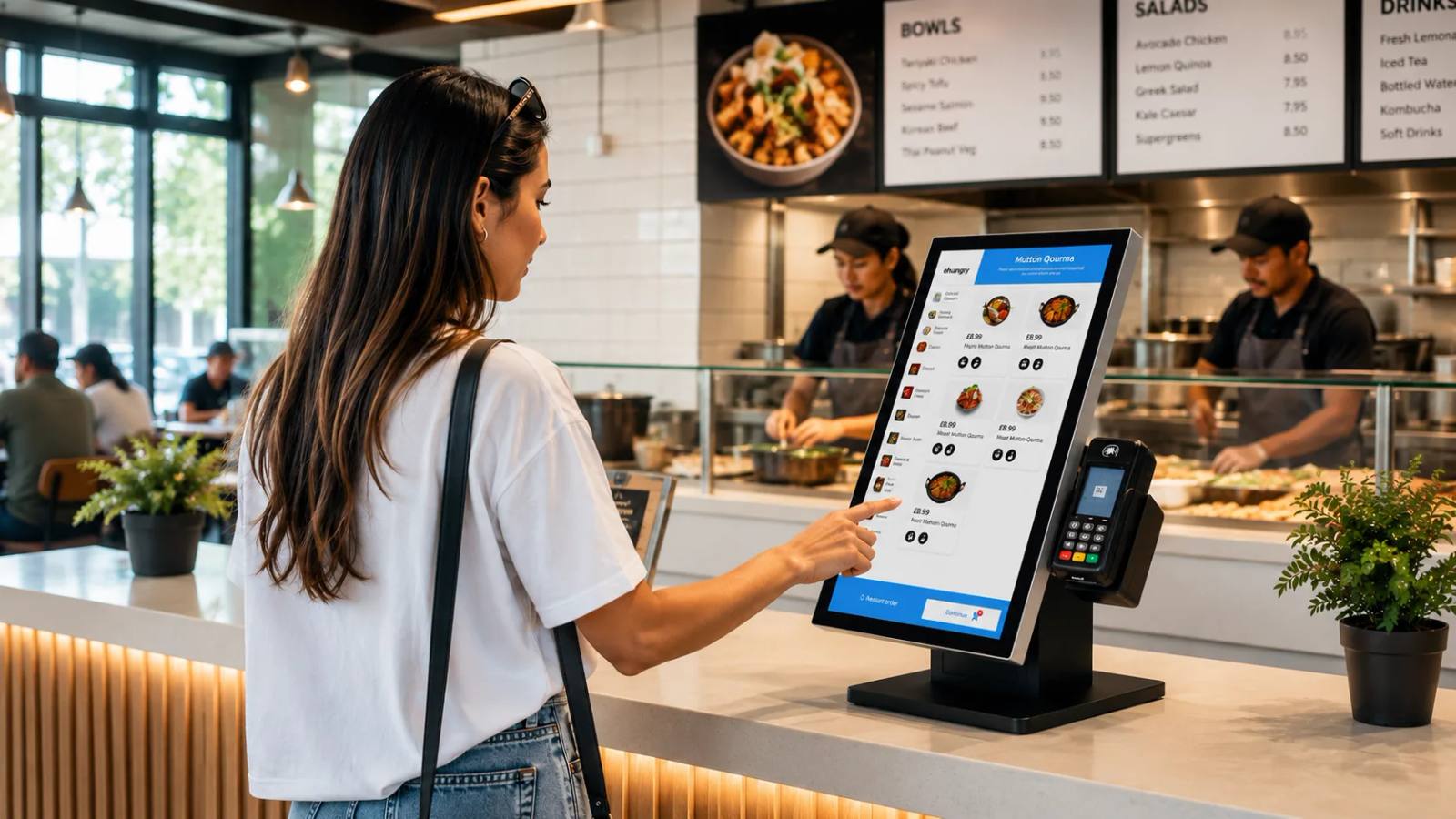
A self-service kiosk doesn’t apply for another job. It doesn’t need a wage rise to stay. It takes the exact task that’s hardest to staff, high-volume, repetitive order-taking. Completely off the table.
What a self service kiosk actually replaces (and what it doesn’t)
Replaces: order-taking pressure
Three or four kiosks running during peak hours handle the volume that would otherwise need two or three extra counter staff on a rota you can’t fill anyway.
Replaces: peak-hour bottlenecks
Multiple kiosks process orders simultaneously, removing the single-queue bottleneck that a single understaffed counter creates during a rush.
Doesn’t replace: your kitchen team
Kiosks route orders straight to your KDS. Your kitchen still needs people to cook. What changes is how the order gets there.
Doesn’t replace: human judgement
Complex requests, complaints, and customers who need help still go to your team, freed up because they’re not stuck taking routine orders all shift.
The shortage isn’t a shortage of people willing to work in hospitality. It’s a shortage of people willing to do the most repetitive part of the job, at the wage currently on offer.
The maths that makes this an easy decision
A typical hospitality worker on the National Living Wage now costs considerably more than the headline rate, once employer National Insurance and pension contributions are factored in, closer to £16.50 an hour than the advertised £12.71, before recruitment costs or cover for absence are added. (Chefs Bay, 2026) That’s before you’ve even managed to find someone to fill the role.
A kiosk has no NI contribution, no pension, no holiday pay, and no resignation letter after eight months. It also doesn’t need replacing every time turnover hits, and hospitality’s 52% turnover rate means most operators are replacing the same role more than once a year. (Talos360, 2025)
Every kiosk you deploy is one less position you’re fighting the entire UK labour market to fill.
Beyond staffing considerations, kiosks can influence several parts of the customer journey. Discover the advantages of self-service kiosks for restaurants
This isn’t about running a leaner team for its own sake. It’s about putting your existing, hard-to-replace staff where they add the most value: the kitchen, the floor, the customers who genuinely need a person, instead of burning them out on the part of the job.
A screen can do just as well, every single shift, without ever calling in sick.
The staffing crisis in UK hospitality isn’t resolving itself any time soon. Vacancies easing doesn’t mean the problem is solved; it usually means operators have simply cut hours, shortened rotas, or closed on quieter days to cope. (Chefs Bay, 2026)
That’s not a solution. It’s a venue operating below capacity because it can’t staff above that level.
Self-service kiosks give you a third option: keep your hours, keep your service standard, and stop depending on a labour market that isn’t giving you what you need.
Stop letting the staffing crisis decide your opening hours
Kayana’s self-service kiosks are built for hospitality venues facing exactly this problem.
Fully integrated with your EPOS and kitchen, live within 7 days, and ready to take the pressure off your team from day one. Let’s talk about what this looks like for your venue.
For businesses considering automation, one important question is how kiosks compare with traditional staffed checkouts. Explore self-service kiosk vs staffed checkout