
The Real Cost of Long Queues: How Self-Service Kiosks Boost Revenue per Hour
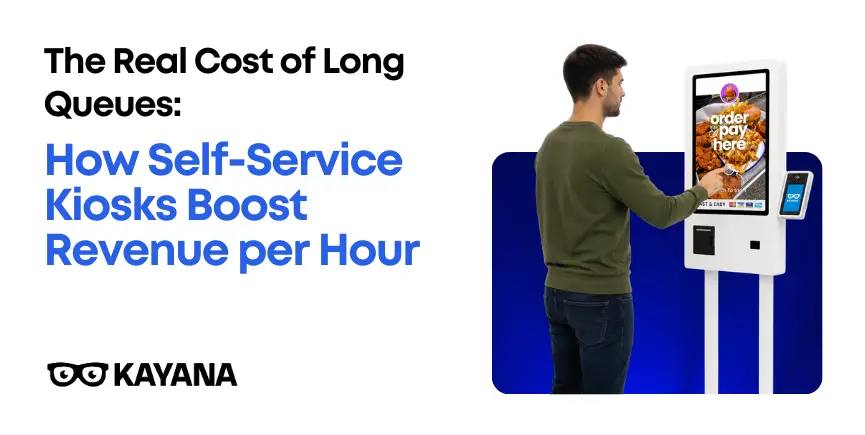
How QSRs are losing revenue every hour they don't act on wait times and what the numbers actually look like.
There's a version of this story every QSR operator knows. The lunch rush hits. The queue snakes past the door. A few people glance at it, turn around, and leave. No complaint. No record in your EPOS. Just gone.
That quiet exit is costing you more than you realise. And the uncomfortable part? It doesn't show up anywhere in your end-of-day reporting.
These aren't edge cases. They're what's happening in your restaurant right now, on every busy shift, at every bottlenecked counter. The question isn't whether queues are costing you money. It's how much.
The maths of a slow counter
Let's put some real numbers to this. A mid-sized QSR serving roughly 120 covers during a two-hour lunch peak, with an average spend of £9.50 per head. That's £1,140 of potential revenue in 120 minutes. Tight margins, tight timing.
Now introduce a queue that regularly hits six or seven people deep. Research consistently shows that customers will start abandoning if the line looks longer than four people. (Restroworks, 2025) If just 10% of potential customers walk away during that window, you're losing £114 before they've even looked at your menu. Every lunch service. Five days a week.
That's over £29,000 a year. In the walk-outs you never tracked.
Reducing queue times is only one part of the potential value of kiosk technology. Explore the wider advantages of self-service kiosks for restaurants.
One percent sounds small. But for a QSR turning over £800,000 annually, that's £8,000 in extra revenue from shaving seven seconds off an order. Seven seconds. That's how sensitive the maths gets during peak hours.
Why queues stay long even when you're fully staffed
Here's something a lot of operators don't account for: queues aren't always long because you're short-staffed. They're long because your counter is a bottleneck by design. One channel. One interaction at a time.
A staff member takes an order, handles a query, processes a payment, gives change, and moves to the next person, all sequentially, all at the counter.
Self-service kiosks break that bottleneck by running multiple ordering channels simultaneously.
Three kiosks running during your lunch peak means three customers placing and paying for orders at exactly the same time.
Your counter staff shift from order-taking to order-making, which is faster, more consistent, and far less error-prone.
Restaurants should also think about how kiosks connect with the rest of their technology. Find out whether you need separate systems for EPOS, kiosks, KDS and payments.
The practical result is striking. QSRs implementing self-service kiosks report order processing times dropping by up to 40%, with queues shrinking by 25 to 40% during peak periods. (Lavu, 2025) More customers served per hour. More revenue per shift. Without hiring a single extra person.
Wondering what this looks like for your specific operation?
Kayana works with QSRs across the UK to model the revenue impact of self-service kiosk deployment against their actual peak-hour traffic.
The upsell your staff don't have time to make
There's another revenue leak that gets less attention: the upsell that never happens.
Your counter staff are good at their jobs. But when there's a queue six deep and the kitchen is shouting, they're not suggesting the upgraded combo or asking if the customer wants to add a dessert. They're processing orders as fast as they can. That's rational. It's also quietly expensive.
A kiosk doesn't feel the pressure of a queue. It prompts every single customer, every single order, with the same calm suggestion. "Add a side for £1.50?" "Upgrade to large?" These aren't pushy tactics.
Queue-related revenue loss isn't unique to restaurants. Similar challenges can affect other customer-facing businesses, including salons. Explore why beauty salons lose revenue during peak hours.
They're well-timed, visual, and easy to say yes to. And the numbers are consistent across the industry: kiosk orders run 15 to 30% higher in average value than counter orders. (TechLink, 2025)
PDQ Chicken reported a 25% increase in average ticket size after kiosk implementation. (GRUBBRR, 2026) Taco Bell found that customers on digital self-ordering spent 20% more than those ordering at the counter.
The pattern holds because the mechanism is consistent: more time, less pressure, better visual presentation of options.
What the revenue picture actually looks like
| Illustrative Scenario — Mid-Sized QSR, Two-Hour Lunch Peak | |
|---|---|
| Without kiosks | With kiosks |
| Covers served: 120 customers | Covers served: 138 customers (+15% throughput) |
| Avg. order value: £9.50 | Avg. order value: £10.90 (+15% via upsells) |
| Estimated walkouts (10%): 12 customers lost | Walkouts: Significantly reduced |
| Upsell rate: Low (staff under pressure) | Upsell rate: Consistent on every order |
| Peak revenue: ~£1,140 | Peak revenue: ~£1,504 (+32%) |
That's not a theoretical best case. It's a conservative read of what the published data shows across QSR deployments. And it compounds: more customers served per hour, at a higher average spend, with fewer staff hours dedicated to routine order-taking.
The four revenue drivers, summarised
- More customers served per hour- 40% faster order processing; queues shrink 25–40%
- Higher average order value - 15–30% uplift via consistent kiosk upsell prompts
- Fewer walkouts during peak - Multiple ordering channels reduce visible queue length
- Labour redeployed to the kitchen - Staff focus on food, not order-taking
What about the customers who prefer the counter?
This is a reasonable concern, particularly when thinking about older customers or those who aren't comfortable with touchscreens. The answer isn't to replace your counter entirely. It's to give customers a choice.
Most QSRs running kiosks keep one or two staffed counter positions alongside them. What changes is the ratio.
Instead of three staff members taking orders and one managing food, you might have one staff member supporting the counter and two focused on the kitchen.
The kiosks handle the volume. The counter handles the exceptions.
65% of QSR customers say they prefer ordering at a kiosk over a staffed counter. (Elo, 2024) The remaining 35% still have somewhere to go. Nobody's left behind. The queue just stops being the only option.
The cost of waiting another year
The conversation about kiosks has shifted. A few years ago, they were a differentiator. Something the bigger chains had that gave them an edge. In 2026, they're becoming the baseline.
Globally, restaurant kiosk installations have grown 43% in two years and are projected to nearly double again by 2028. (Datos Insights, 2024)
Every week without them is another week of peak-hour walkouts you didn't record, upsells you didn't make, and revenue per hour that stayed lower than it needed to be.
The queue outside your restaurant during lunch isn't a sign of popularity. It's a signal. The question is what you do with it.